
- Products description
- Manufacturer Information
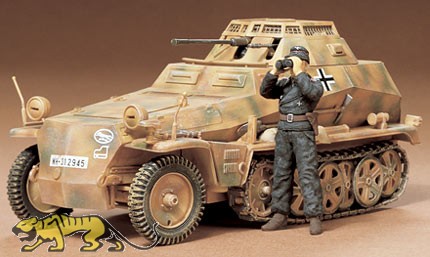
German Sd.Kfz. 250/9
1/35 scale plastic model kit of the german Sd.Kfz. 250/9.
About the model:
- 1/35 scale plastic model assembly kit
- The front wheels are movable
- The canon is movable
- Contains 1 figure with field glass
The SdKfz 250 was a light armoured half track, similar in appearance to the larger Sdkfz 251, used by Nazi Germany in World War II. The "250" had 4 roadwheel axles, compared to 6 for the 251. The SdKfz-251 had a three-ton cargo capacity, compared to one ton for the smaller and lighter SdKfz-250. Viewed from the front, the two vehicles appear very similar.
Compared to US halftracks, the SdKfz 250 series was less mobile, with unpowered front wheels. However, its tracks made it far more mobile than the armoured cars it replaced, and it was a popular vehicle. Most variants were open-topped and had a single access door in the rear.
The vehicle was used in a wide variety of roles throughout World War II. The basic troop carrier version was used as an armored personnel carrier for reconnaissance units, carrying scout sections. This basic variant usually mounted one or two MG34 machineguns. Later variants carried 20mm, 37mm, and even 75mm guns to support the more lightly-armed versions (see table below).
Several special-purpose variants were seen early in the war. The 250/3 and 250/5 were command variants, equipped with fewer seats but with long-range radio equipment. These were used by battalion and higher commanders as personal command vehicles, most famously the 250/3 used by Erwin Rommel in the North African campaign. Early versions had large 'bedframe' antennas that were easy to spot at long range, making them vulnerable to artillery fire. Later variants dispensed with this antenna and used a whip antenna instead.
The Sd.Kfz 253 variant was fully enclosed, and was used by artillery forward observers to accompany tank and mechanized infantry units.
The initial design had an armoured body made of multi-faced angled plates which gave good protection against small arms fire, but which made the design both expensive to manufacture and quite cramped. The second version ("neue art" or "new version") appeared late in 1943, and was greatly simplified to speed up manufacture. In both variants, the armour was useful only for stopping small-arms fire and small artillery fragments. Heavy machinegun fire, anti-tank gun fire, or almost any tank could penetrate the Sd.Kfz-250 at long range.
3-7 Ondawara, Suruga-Ku
Shizuoka, 422-8610
Aichi, Japan
Werkstraße 1
90765 Fürth
Germany
info@tamiya.de


Manufacturer: Tamiya
Item-No..: 85080









Axels Modellbau Shop © 2026 | Template based on modified eCommerce Shopsoftware 2025-2026 by Axel's Modellbau Shop Schulze & Sohn OHG