
- Products description
- Manufacturer Information
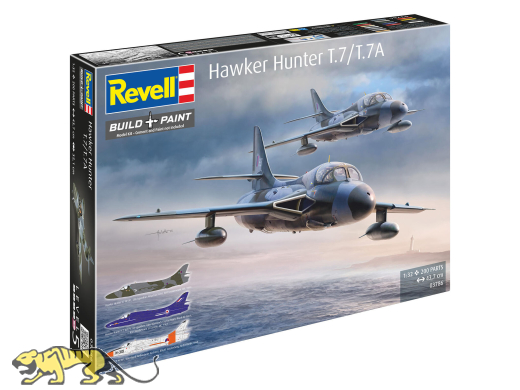
Hawker Hunter T.7/T.7A
1/32 scale plastic model assembly kit of the Hawker Hunter T.7 / T.7A, two seat trainer version of the Hawker Hunter.
About the model:
- 1/32 scale plastic model assembly kit
- Highly detailed model
- Length: 437 mm
- Wingspan: 321 mm
- Total parts: 200
- New cockpit, nose and exhaust parts
- Canopy and flaps can be built open or closed
- 2x instrument panels (T.7 & T.7A version)
- Markings for three versions:
Hawker Hunter T.7 XL591, 208 Squadron, Royal Air Force, RAF Lossiemouth, UK, 1990
Hawker Hunter T.7 XL571, 92 Squadron, Blue Diamonds Display Team, Royal Air Force, RAF Middlestone St. George, UK, 1961
Hawker Hunter T.7 N-301, KLu, Royal Netherlands Air Force, RNLAF Soesterberg, Netherlands 1968
History:
The Hawker Hunter T.7 was the two-seat training version of one of Britain’s best-known post-war jet aircraft. The original Hunter was developed during the early 1950s as a single-seat day fighter for the Royal Air Force. With its sharply swept wings, streamlined fuselage and powerful Rolls-Royce Avon turbojet engine, it represented a new generation of British combat aircraft. Entering RAF service in 1954, the Hunter later developed from an interceptor into a highly capable fighter-bomber and reconnaissance aircraft.
To provide pilots with safe and effective conversion training for the demanding single-seat fighter, Hawker developed a dual-control version. The first prototype Hunter trainer made its maiden flight in July 1955. In place of the narrow single-seat nose, the T.7 featured a wider and extended forward fuselage accommodating the student pilot and instructor side by side. Despite this distinctive modification, the aircraft largely retained the elegant appearance and excellent handling qualities of the single-seat Hunter.
The Hunter T.7 entered service in August 1958, initially with No. 229 Operational Conversion Unit at RAF Chivenor. It was used to convert new pilots to the Hunter, conduct continuation training and support a variety of training and test establishments. Many operational Hunter squadrons kept at least one two-seat aircraft on strength, allowing pilots to carry out instructional and proficiency flights with an experienced instructor. The T.7 was also fitted with a single 30 mm ADEN cannon in the nose, enabling elements of operational and weapons training to be included.
Six aircraft were subsequently converted to Hunter T.7A standard. These machines received instrumentation based on that of the Hawker Siddeley Buccaneer and were operated by No. 237 Operational Conversion Unit at RAF Lossiemouth. They were used to prepare pilots for the powerful low-level strike aircraft. Externally, the T.7A remained almost indistinguishable from the standard T.7, but its modified cockpit provided valuable training in Buccaneer instruments and operating procedures.
Thanks to its excellent handling, reliability and versatility, the two-seat Hunter enjoyed an exceptionally long British service career. Individual aircraft remained in use until 1994, approximately four decades after the original Hunter’s first flight. The T.7 and T.7A therefore represent two of the most important training versions of this classic British jet, combining the Hunter’s graceful appearance with a particularly interesting operational history.
Henschelstr. 20-30
32257 Bünde
Germany
shop@carrera-revell.com
Manufacturer: Airfix
Item-No..: A04301V
Manufacturer: Tamiya
Item-No..: 81354







Axels Modellbau Shop © 2026 | Template based on modified eCommerce Shopsoftware 2025-2026 by Axel's Modellbau Shop Schulze & Sohn OHG